


This post is also available in:


Scheduling problems in enterprises rarely look dramatic. They show up as a dozen small delays that keep repeating.
A client reschedules, and no one updates the right calendar. A request lands with the wrong team.
A VIP appointment gets double-booked. A patient intake form is missing. An advisor is fully booked, while a room sits empty.
Individually, these are considered “small admin issues.” However, at an enterprise scale, this quickly becomes an operational issue. Teams spend more time coordinating than actually delivering service.

More enterprises are turning to AI-assisted booking tools. In particular, team.blue is building AI into its ecosystem to make operations faster and more personal.
When booking shifts from manual coordination to smarter automation, enterprise teams typically see seven clear efficiency gains.
In this article, we’ll break down what those gains actually look like in practice, with examples across legal, education, healthcare, and retail, so you can quickly map the ideas to your world and see where the biggest wins might be hiding.


What does ”AI-assisted booking” mean in an enterprise setting
In an enterprise setting, AI-assisted booking tools are scheduling systems that take care of the busywork, using automation, rules, and smart assistance to manage the back-and-forth for you.
Instead of someone manually checking calendars, chasing confirmations, and fixing mistakes, the system follows your logic and keeps the booking on track.
The real win with AI scheduling automation is consistency. The system applies consistent rules for services, timing, eligibility, and routing across departments and locations.
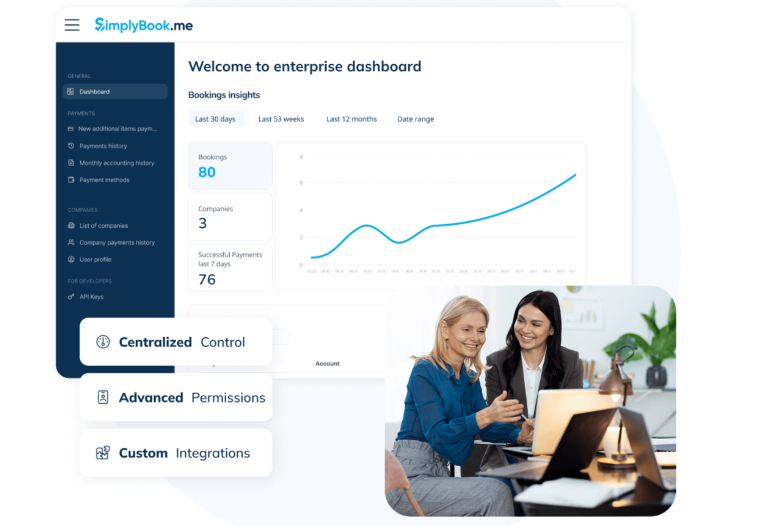
That’s also where SimplyBook.me Enterprise fits in. It’s an ISO 27001-certified booking solution built for larger organizations that need secure, flexible scheduling across teams and locations.
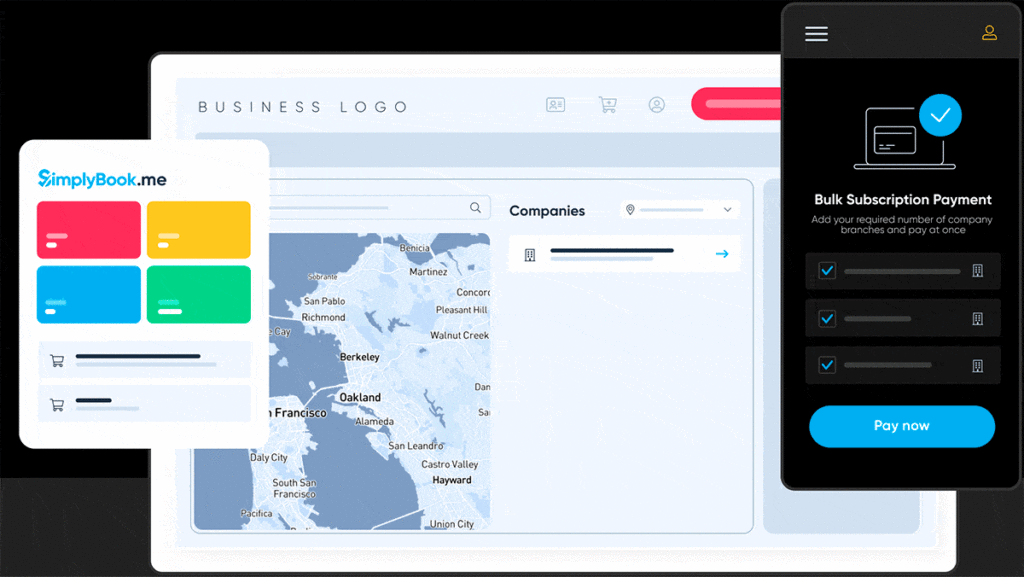
It supports location management, custom reporting, and API integrations, plus tools like email/SMS reminders, intake forms, and a client app to improve efficiency and customer experience.
It works for internal or external bookings, supports multiple languages, and can be deployed in the cloud or on-premises.

Why scheduling gets harder at scale
If you’re running scheduling in one team, in one location, it might be manageable. Adding departments, locations, or policies can add complexity. Then, booking becomes an operational struggle.
As you scale, here’s what usually makes it harder:
- Multi-location and time zones: Scheduling across regions introduces complexity quickly. When teams operate in London, New York, and Dubai, a 10:00 am booking becomes ambiguous without proper time zone handling.
Add different opening hours, holidays, and staff schedules, and mistakes happen fast. That’s why AI scheduling automation matters so much.
- Shared resources (rooms, equipment, specialist stuff): In an enterprise, you’re not just booking a person, you’re also booking the room or equipment they need.
If two teams double-book the same space or specialist, everything gets delayed, and your staff ends up sorting it out instead of focusing on customers.

- Approvals and eligibility rules: You can’t let anyone book anything. Some appointments need a quick sign-off, and some slots are reserved for specific teams, client tiers, or case types, so the right work goes to the right people.
Without those guardrails, bookings end up in the wrong queue, your team has to untangle them, and the customer experience gets damaged.
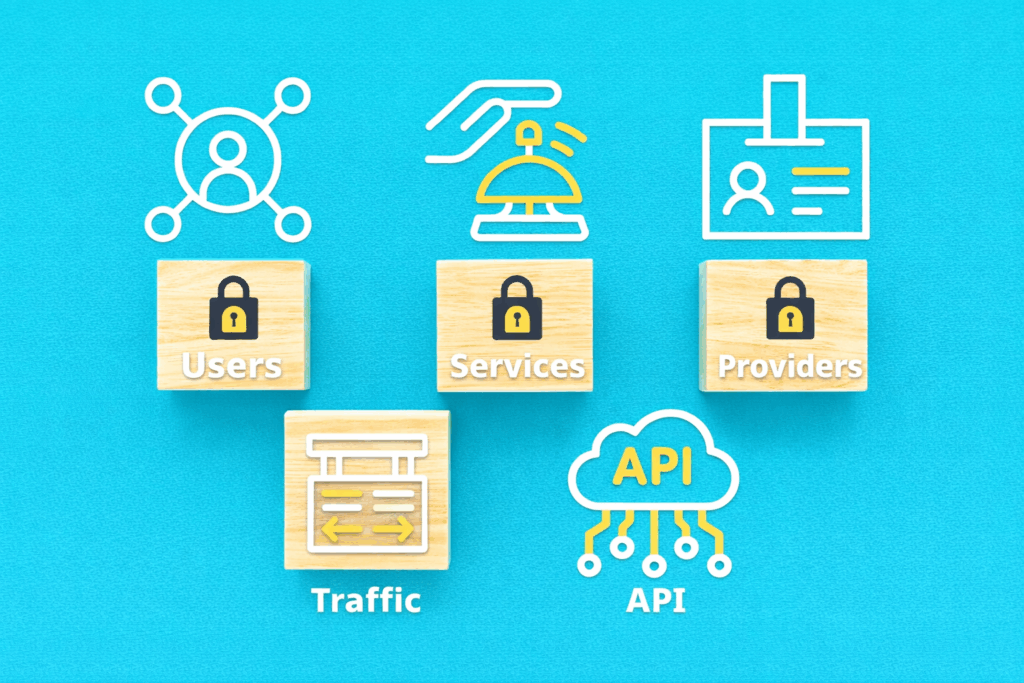
- Security and compliance requirements: In enterprise settings, scheduling is more complicated. You’re often handling personal or sensitive details, so you need clear rules for who has access to what, who can make changes, and a clear record of every action.
So, things like access controls, audit trails, and data handling policies have to be built into the booking workflow, especially in regulated environments like healthcare, legal, and education.


7 Efficiency Gains Enterprises Achieve with AI Booking Tools
AI booking tools give your teams a measurable operational advantage.
Here are seven efficiency gains your enterprise achieves when AI automation replaces manual booking processes:
1) Less admin time spent coordinating appointments:
Scheduling usually isn’t the hard part. Most of the time, it’s all the stuff around it. Checking calendars, confirming details, rescheduling, and pulling in the right people. Across multiple teams and locations, that coordination gets expensive fast.
AI-assisted enterprise booking tools cut the noise by turning scheduling into a simple self-serve flow that still follows your rules. Fewer emails and calls, fewer messages, and more focused work.
Examples
- Legal: Consultations route to the right practice area with the correct duration without receptionist back-and-forth.
- Education: Advising and office hours get booked without manual calendar juggling.
- Healthcare: Patients select appropriate providers and time slots with fewer staff interventions.
- Retail: VIP appointments and fittings get confirmed faster with less coordination.
In fact, institutions can save up to 30% of time on scheduling and admin tasks when booking is automated and standardized.

2) Automated matching to the right person or service
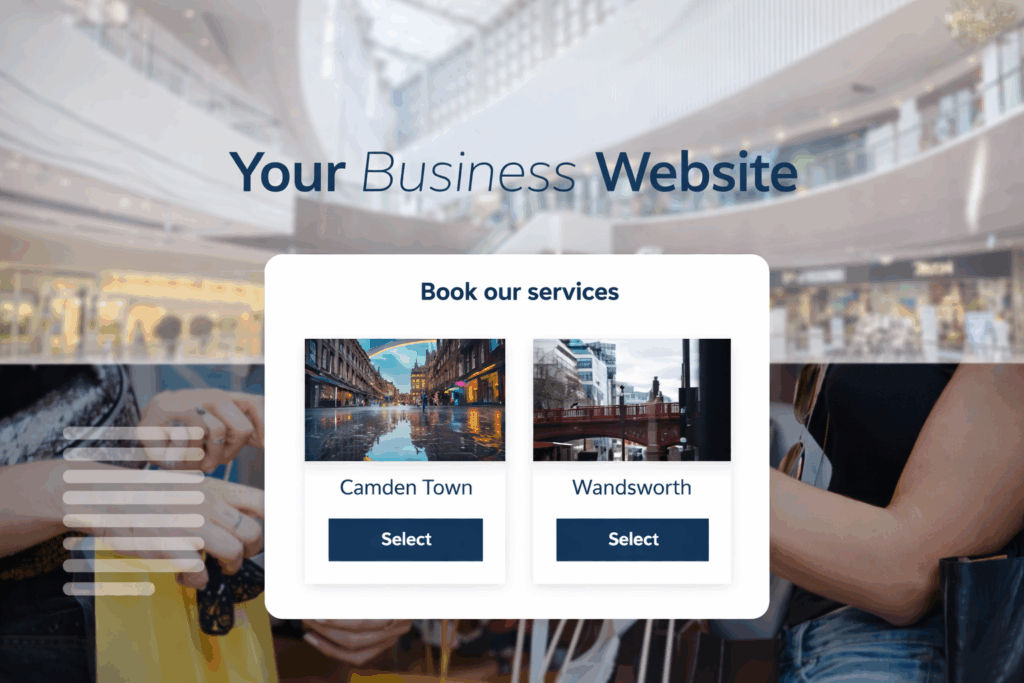
With enterprise scheduling software that routes requests automatically, bookings stop bouncing between teams. Legal intakes route to the right practice area, students to the correct advisor, patients to the appropriate clinic, retail clients to the right specialist.
This matters even more in global organizations, because Microsoft reports 30% of meetings now span multiple time zones, so a small routing mistake can quickly turn into delays, rework, and missed appointments.
3) Fewer booking errors and last-minute fixes
Booking errors in enterprises are predictable. Someone books the wrong service length, picks the wrong appointment type, double-books a room, or skips required forms, and then your staff fixes it under pressure.
AI tools guide users through the correct steps and validate each booking. Duration, appointment type, staff, or other prerequisites are all checked before confirmation. At scale, this prevents minor errors from leading to inconsistent experiences across your locations.
4) Higher resource utilization without additional headcount
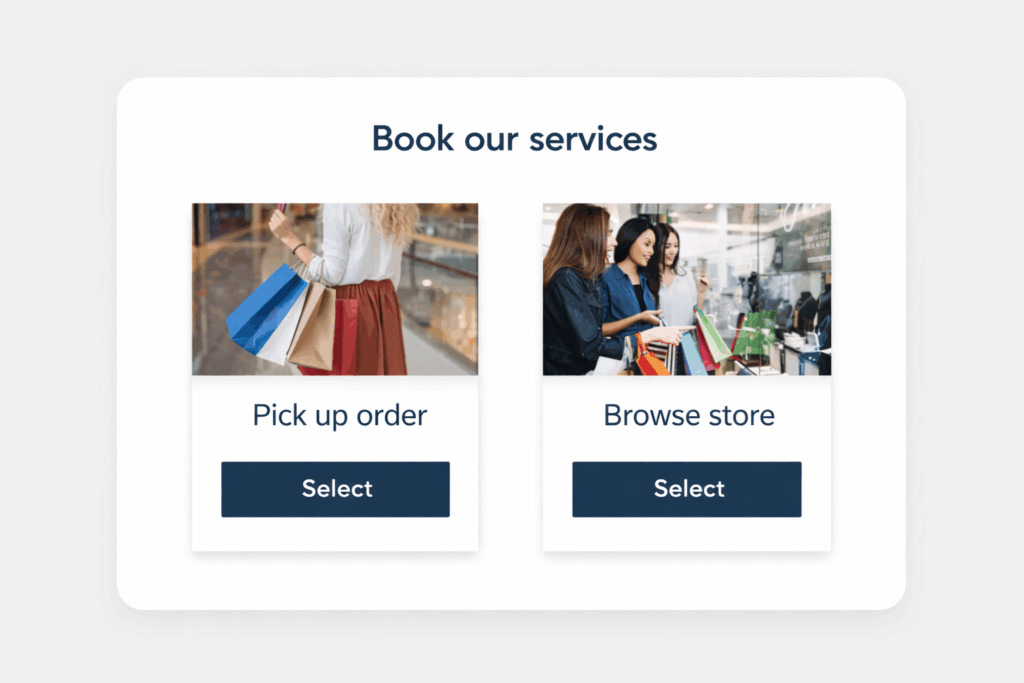
The problem isn’t getting enough bookings; it’s losing the slots you already have. Cancellations leave gaps. Resources sit empty. And when something opens up, your schedule can’t adapt fast enough to fill it.
AI scheduling fixes this. It runs waitlists automatically, fills small gaps between appointments, and adds smart buffers, so you’re not wasting time or rushing teams. You get more out of the people and resources you already have, without hiring anyone new.

5) Fewer no-shows through automation and pre-commitment
No-shows don’t just leave an empty slot on the calendar. They throw the entire operation off balance, staff are forced to improvise, rooms and equipment sit idle, and the rest of the day gets rearranged on the fly.
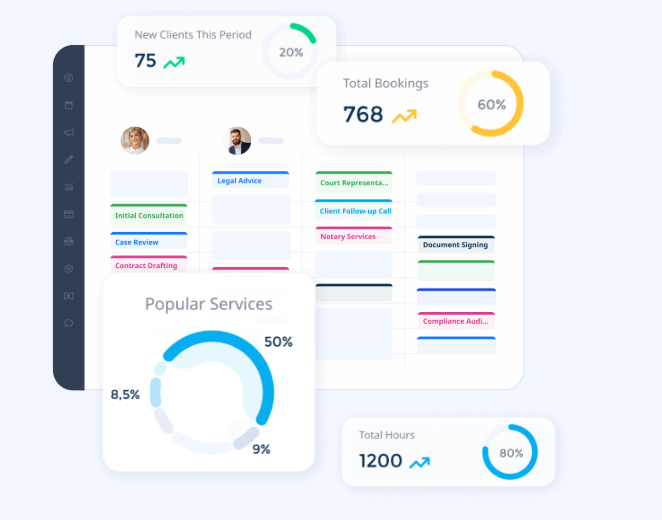
With AI-assisted booking tools for enterprises, you can automate the basics that consistently move the needle: instant confirmations, email/SMS reminders, quick rescheduling links, and, when it fits the service, deposits or prepayments. That mix does two things at once. It nudges people to show up, and it gives you a faster way to recover the schedule when they don’t.
Typical reductions look like this:
- Legal: up to 25% fewer no-shows
- Education: up to 30% fewer missed sessions
- Healthcare: up to 35% fewer no-shows

6) More consistent service across departments and locations
In large organizations, inconsistency costs money. One location confirms instantly, another takes two days. One team captures the right details upfront, another misses key information. The customer experience depends on who they happen to reach.
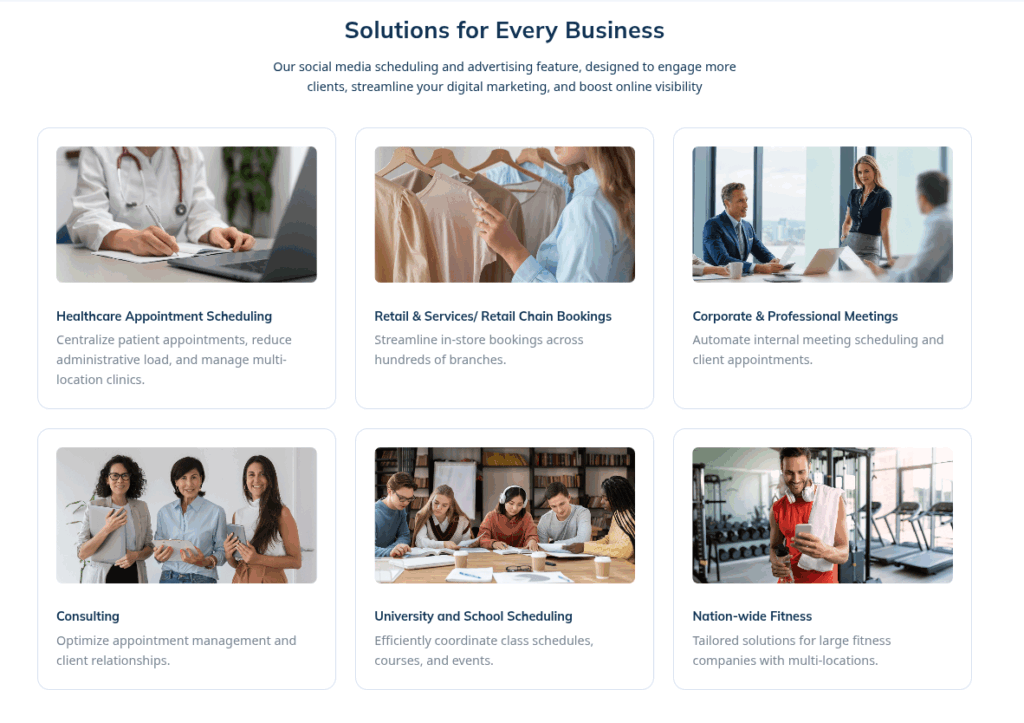
AI booking tools let HQ set standard rules while local teams maintain flexibility. Departments apply the same framework without having to rebuild processes.
Education ensures consistent multi-campus scheduling, even when campuses operate differently. Legal maintains the same intake and routing logic across offices and regions. Healthcare aligns appointment rules across clinics and departments. Retail chains deliver consistent VIP booking experiences across stores and time zones.

Enterprise snapshot: NHS Trust (SaTH)
The Shrewsbury and Telford Hospital (SaTH) NHS Trust in the UK rolled out SimplyBook.me Enterprise during COVID-19 to manage vaccination bookings across 15 locations, getting it live in up to 4 weeks, then expanding it to mask fittings and phlebotomy. What stood out for their team was the flexibility: they could configure the setup for each site’s needs, share a simple booking link for staff and patients, and block off sessions fast when staffing changed.
7) Clear reporting that identifies operational issues
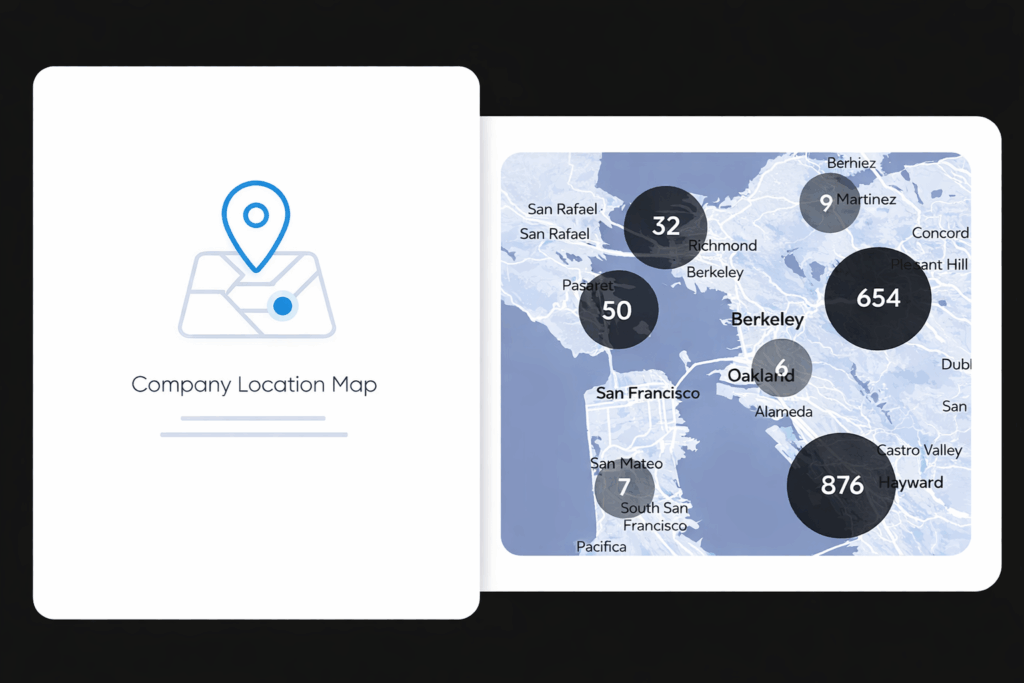
An enterprise scheduling software gives leaders clear visibility through reports and analytics: which services are in the highest demand, when peak times hit, which teams are overloaded, and where cancellations create gaps. The patterns usually point to a few root causes such as limited capacity, uneven staffing, or a complicated booking flow.
Final Thoughts
With AI-powered scheduling tools, you get automation that actually delivers. Automated confirmations, smart reminders, better routing, streamlined intake, and fewer gaps from cancellations.
If you’re managing multiple teams or locations, take a closer look at your booking process. See where demand spikes, where people drop off, and where handoffs fail. Then choose a platform that creates consistency across the board while giving local teams the flexibility they need.
Ready to see it in action?
Book a walkthrough. We’ll show you how an all-in-one solution reduces no-shows, eliminates scheduling problems, and gives leaders the visibility to address issues before they escalate.
FAQ
AI-assisted booking tools for enterprises use rules, automation, and smart assistance to manage scheduling at scale, across locations, teams, and services.
A simple link shares availability. Enterprise scheduling software adds governance: permissions, rules, multi-location control, reporting, and integrations.
No. In enterprise scheduling, AI usually works behind the scenes to route requests, prevent errors, send reminders, and keep workflows consistent.
It removes the back-and-forth: confirmations, reminders, reschedules, rule checks, buffers, and routing. Your teams stop chasing bookings manually.
Because misrouted bookings create rework. Good routing sends each booking to the right person, place, or service the first time.
Wrong duration, wrong service type, double-booked rooms/resources, and missing prerequisites like intake forms or approvals.
By filling gaps from cancellations, using waitlists, and applying smarter buffers, resources stay in use without overloading teams.
Reminders make attendance harder to forget, rescheduling easier, and deposits or prepayments add commitment for high-value appointments.
Visibility into demand peaks, workload distribution, cancellations/no-shows, and recurring friction points so scheduling becomes a measurable ops issue.
SimplyBook.me Enterprise supports multi-location management, custom reporting, API integrations, branded booking flows, and enterprise-grade security options for internal or external bookings.